
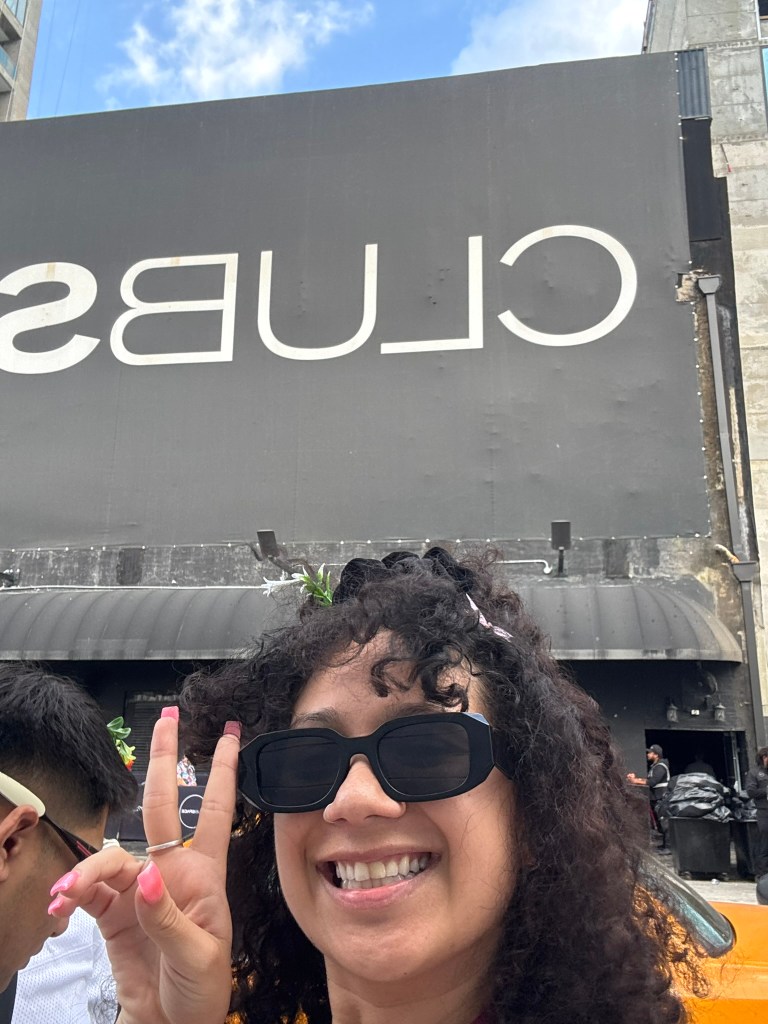
Personal Archive leaving Club Space at 11:30am
Before I begin my first blog, I like to take a moment to describe what counter-archives mean to me. So counter-archives are a type of archival practice that challenges dominant, colonial, elite, and state-sanctioned ways of documenting history. Unlike traditional and colonial archives that are found in libraries, museums, or academic institutions (often shaped by elites and exclude marginalized people of color voices), counter-archives prioritize the incomplete, erased, and everyday stories of marginalized communities of color. They go beyond physical documents and elite art forms, which I argue include oral histories, digital media, memory, and lived experience. Counter-archiving is about reclaiming the power to define what is worth remembering, preserving, and valuing.
The first thing I noticed in Miami was not the music. It was the humidity. It clung to my skin, curled my hair, and made me feel oddly at ease. In a city shaped by Black and Latinx presence, I began to notice how frizz, sweat, and breath were not just tolerated, but they were allowed. This looseness, this permission, felt like lo sucio in motion. Not just performance or sexuality, but atmosphere. Climate. Texture. The way a space lets the body exist without apology. In this blog, I explore what happens when we read sweat, humidity, and frizz as part of lo sucio’s sensory geography, and how club spaces like Miami’s Club Space become counter-archives of softness, survival, and refusal.
What if frizz was a theory? What if sweat was a site of resistance?
As I moved through Miami’s heat, its patios, its dancefloors, its grilled cheese breaks—I started to think about lo sucio framework by Deborah Vargas beyond the usual frames of performance, smell, and sexuality. What if climate, hair, and breath could also be part of a counter-archive? What if the refusal to cool down, to be composed, to be “clean,” was the theory itself?
As I reflect my visit to Miami, I am building on lo sucio by expanding its sensory and spatial dimensions beyond smell, performance, and sexuality into climate, hair, and cultural permission.
Deborah Vargas’ in “Ruminations on Lo Sucio as a Queer Analytic” (2014) invites us to think about the unsanctioned, the unruly, and the excess, especially through bodies that do not conform to neat borders of respectability or normativity. What I noticed in Miami is how humidity, sweat, and frizziness contribute to this looseness. It is not only that frizzy hair happens but it is allowed to exist without shame. That feels like lo sucio as a site of safety, pleasure, and belonging.
In Los Angeles and San Diego, beauty feels like a performance of containment. Where whitewashed aesthetics circulate through influencer culture, frizz is something to “fix,” sweat is something to hide, and climate control becomes a kind of bodily discipline. Coldness, in the form of sleek air-conditioned interiors, flattening filters, and lace fronts glued tight, is part of a racialized demand to stay cool, polished, and composed.
Reading Cooling the Tropics by Hi‘ilei Julia Kawehipuaakahaopulani Hobart, I began to see this not just as an aesthetic choice but as a colonial conditioning of the senses. This made me think about how coldness functions not just as an aesthetic but as a form of control. In Cooling the Tropics, Hobart teaches us that coldness is not neutral but has a history. In Hawai’i, the introduction of artificial cold became a tool of settler colonialism, used to reshape Indigenous relationships to land, labor, and body. Air conditioning, refrigeration, and even ice itself were embedded in a racial imagination that framed heat, moisture, and the tropics as uncivilized needing discipline, needing cooling.
So what happens when I step into Club Space and feel the opposite?
There, the first floor of Club Space becomes a kind of patio of permission, not because it is where the heat lives, but because it is where the body is allowed to pause. It is where people sit down to breathe, snack on grilled cheese, and cool off after being drenched in movement. It is a space that honors limits, where taking a break is not failure but part of the rhythm. And then there is the terrace, the second floor, where things get hot—literally and metaphorically. Up there, the air thickens with sweat, bodies press together, frizz blooms without apology, and the music demands surrender. Frizz is not corrected. Sweat is not shamed. The architecture does not demand composure; it lets us come undone. In this refusal of colonial cool, the club becomes more than a party; it becomes a counter-climate archive, where softness and survival are allowed to coexist.
As an L.A. local, my wigs and extensions are both survival and beauty protective styles that help me navigate aesthetic expectations shaped by colonial standards of composure. But in Miami, surrounded by Black and Latinx bodies moving freely, I felt safe enough to imagine letting go of that control. That imagined possibility itself felt like a kind of softness, a climate-induced release what I am starting to think of as suciedad politics: the political potential of being undone, uncontained, unbothered by the heat.
If Hobart shows us that coldness is part of the settler colonial project, then spaces that embrace heat, humidity, and bodily messiness offer a refusal. They hold the potential to reorganize the racial imaginary through texture, temperature, and touch. The club’s AC corners do not discipline; they soothe. The dancefloor does not demand performance, it permits presence.
This, to me, is the heart of counter-archiving: documenting what gets discredited as too much, too sweaty, too messy, too soft, and showing how these very states hold memory, resistance, and life.
Let my curls be theory. Let the sweat be citation. Let the heat remind us that not everything needs to be cooled to be cared for.
 Counter-Archives from the Dancefloor
Leave a comment