
For my HoneyLuvers, this one’s for us. The ones who feel the bass in our chest like a heartbeat, who find home on the dancefloor, who know sound is a form of resistance.

This blog centers on Taylor Character, known as HoneyLuv, a Black woman house DJ from Cleveland, Ohio. I was drawn to her work not only for its deep house and Chicago-style roots, but for the way she moves through a male-dominated, white-centered music scene with undeniable presence and purpose. Over the past year, I have experienced several of her sets in person, each one transporting me to the Midwest, creating a visceral sense of place, memory, and belonging through sound. But it is not just the music, it is the full scope of her artistry. HoneyLuv’s aesthetic choices, community engagement and political commitments (like connecting with fans and speaking out against discrimination) all reflect care, resistance, and radical imagination. Recently, I interviewed her because her presence in the scene feels powerful and necessary. In this essay, I place her reflections in conversation with her DayTrip in the Park set from September 2024, drawing connections between her music and the broader themes of care, resistance, and radical imagination. These themes embody layered histories and futures that transform the dancefloor into a living archive of Black radical imagination.
HoneyLuv’s DayTrip In the Park Full Set via YouTube
I approach the dancefloor here as a living archive: a dynamic, evolving space shaped by those who engage with it through storytelling, sound, and movement. Unlike traditional archives, it centers the voices and experiences often erased which invites reinterpretation, contribution, and resistance. It asks: Who gets to tell the story? Who is remembered? And how do we archive ourselves and our truths when no one else will? I ask Honeyluv what does it mean to her to be a Black woman DJ in a male-dominated space? She responds:
“It means breaking boundaries every time I step behind the decks. I’m not just showing up for myself…I’m representing the ones who never got the mic, who were told they couldn’t, and who still push culture forward in the shadows. It’s about being undeniable, taking up space with confidence, and shifting the narrative just by being excellent at what I do.”
In this way, HoneyLuv is not just mixing tracks, she is preserving lived experience. The DJ booth becomes a counter-archive, where truths are carried in basslines and transitions, remembered through movement and emotion. Her answers to my interview questions illuminate the spiritual and cultural depth of her work and her vision for more liberatory dance floors. While the set I analyze is available online via YouTube, my interpretation is also grounded in the lived, embodied experience of being there in the space, with the sound, feeling the care she cultivated and the world she built in real time.
To bring this experience into sharper focus, I return to memory as a method that embodies emotions and lived experiences. I remember that day as if it were yesterday. It was the last DayTrip in the Park Sunday event of the summer, and the show was completely sold out. I remember that the line wrapped around the venue to enter. The heat pushed nearly 100 degrees which added a type of energy that made everyone move and caught in the rhythm. The crowd, both backstage and in general admission, was full of Black and Latinx people. It was beautiful to see, especially because at past events, the backstage area had mostly been filled with white girls during other DJs’ sets. The event took place at Los Angeles State Historic Park and was designed around a summer, tropical oasis theme kind of like taking a quick trip to paradise, but just for the day. The “DayTrip” sign at the entrance reinforced that feeling, hinting at an escape into a vibrant, sunny world through house music. Disco balls and plants hung from the ceiling, catching the light and adding to the atmosphere of celebration and joy.
HoneyLuv stood out immediately because her aesthetics embodied a style that refused assimilation. She wore a bright yellow “Fresh Picking Cherry” T-shirt with the slogan written in red, paired with a black tennis skirt, gold rings and necklaces, sunglasses, perfectly done nails, and blonde box braids styled into a half-ponytail. When I asked about what inspires her fashion, HoneyLuv shares:
“Fashion is how I speak without words. I pull from streetwear, high fashion, retro energy, and heavily influenced in the 90’s hip hop and R&b culture because I’m all of that. My style is about confidence, fluidity, and intention. I want to look like how my music feels powerful, electric, and unforgettable.”
Her look was loud, playful, and unapologetically Black which Jillan Hernandez (2020) calls an aesthetic of excess that disrupts the minimalist, whitewashed norms often celebrated in dance music spaces. Her fashion, like her sound, refuses to shrink itself. It commands space, celebrates lineage, and speaks directly to those who recognize the language of flair, care, and cultural memory.
This hot and sweaty day mixed with house music at DayTrip was not only about aesthetics though; it set the stage for something deeper. Much like the Free Southern Theater (FST) used performance as a tool for liberation and community healing, HoneyLuv transforms her sets into collective experiences that affirm Black life and joy in spaces often centered around whiteness. At DayTrip in the Park, HoneyLuv’s physical presence, song choices, and crowd engagement choreographed a sense of resistance and belonging that mirrored how the FST used performance as a political intervention. As scholars have described, the Free Southern Theater treated performance itself as a “rehearsal for freedom,” (Fleming, Forsgren, Hilton & Tallie) using embodied practices to imagine and enact liberation. HoneyLuv begins her set with a remix of a Cardi B track, immediately grounding the space in a spirit of sex positivity and empowerment. Hip-hop rapper Cardi B, known for her unapologetic celebration of sexuality, aligns with house music’s historical roots in queer, Black, and Latinx spaces of liberation. As the set builds, HoneyLuv continues weaving this theme into the soundscape, playing a track around the 30-minute mark with the lyrics “work this pussy,” further demonstrating how sex positivity and house music move hand in hand. When I asked her how does her music reflect her or her community, she responds:
“My music is a reflection of freedom, resilience, and joy. It’s the sound of being raised in a city like Cleveland, with deep roots and real soul. It’s unapologetic, bold, and always evolving just like the communities I come from. I carry that energy into every set, blending nostalgia with the future.”
Through these choices, HoneyLuv’s set becomes more than just a musical performance, it becomes an embodied assertion of freedom, pleasure, and community.
Yet HoneyLuv’s work moves beyond the now; it is also rooted in ancestral memory and sonic lineage. In August Wilson’s The Piano Lesson, two siblings’ piano symbolizes their family history and the legacy of slavery. Much like this piano that holds generational trauma, legacy, and the contested right to memory, HoneyLuv’s DJ decks function as her own “piano” where it is a site where she honors her sonic ancestors while remixing the present. She played “Percolator” by Green Velvet and Jamie Jones (she played this at 32 minutes) who are two Black pioneers of house music, with Green Velvet emerging from 1990s Chicago and Jamie Jones from London’s scene who both signal this ancestral presence behind the decks. Her remix of Michael Jackson’s “Billie Jean” continues this homage (she played this at 27 minutes), weaving together past and present Black musical transformation into a celebration of survival, creativity, and collective memory on the dancefloor. I asked if she can share a moment she felt most connected to her ancestors behind the decks and responds with:
“It’s not even one moment….it’s every time I catch that Holy Ghost feeling when I’m deep in the music. It’s like something takes over me. I’m locked in, but also completely free. That’s when I know my ancestors are coming through me. I feel them in my body, in the rhythm, in the way the energy flows from my hands to the crowd. Those moments aren’t just about mixing tracks; they’re spiritual. That’s when I’m most connected to something greater than myself..”
Through her deep engagement as I like to call sonic lineage, HoneyLuv preserves Black musical traditions but also embodies the spirit of everyday rebellion and radical joy. As HoneyLuv speaks:
“I speak things into existence. I visualize. I protect my peace and stay rooted in purpose. The Secret (this book I read) really changed the way I move….now I focus on alignment, not validation. When it gets heavy, I remember why I started. That vision keeps me centered… [I reimagine a safer space for marginalized communities of color on the dancefloor] by making sure the energy is intentional from the jump. Booking diverse lineups, protecting queer spaces, making sure Black and brown people feel like the dancefloor belongs to us. Music should be a sanctuary. I want people to feel seen and free the moment they walk in.”
Her work resonates with Saidiya Hartman’s notion of waywardness in Wayward Lives, Beautiful Experiments, where Hartman centers the imaginative acts and quiet refusals of Black girls and women to be diminished or erased (Hartman, 2019). HoneyLuv’s fashion, sound, and refusal on stage align with this tradition of wayward survival, transforms vulnerability into power and physical exhaustion into collective beauty. During her DayTrip in the Park set, as the sun blazed nearly 100 degrees, the crowd stayed, fanning themselves, bodies glistening with sweat, yet growing only more energized. Around the 20-minute mark, HoneyLuv, visibly sweating, performed her hit collaboration with Jamie Jones, “XTC,” joyfully singing along to the lyrics: “Tryna see where this can lead, chasing a fantasy.” In that moment, the heat and the dancefloor became a space where fantasy, freedom, and interiority win over discomfort and erasure. Staying in the heat, refusing to retreat, and choosing to dance were everyday acts of rebellion against respectability and disappearance. HoneyLuv’s joyful, unapologetic performance turned radical joy into a method of survival and into a practice of thriving. Together, the crowd and HoneyLuv enacted a collective waywardness that Hartman describes, refused containment and instead insisted on pleasure, imagination, and Black freedom in motion.
For HoneyLuv, music is not just sound, it is soul work. “It is the deep basslines and soulful vocals that feel like home, the kind of rhythms that don’t just play, but move through you.” Detroit techno, Chicago house, and Cleveland grit are sonic geographies that carry histories of Black resistance and creativity. To her, DJing is liberation: a way to express power, joy, rebellion, and love when words fall short. It is a healing practice, grounded in truth and purpose, that creates space for others to feel something real. In her hands, the decks become a site of transformation, a place where fantasy meets freedom, where the sacred and the sweaty coexist, and where Black and brown communities are reminded that the dancefloor was always meant to be ours. HoneyLuv does not just play music; she builds worlds. And in those worlds, we are invited not only to survive, but to thrive. DJing to her is her voice when she has no words, a space where she feels most alive, tapped in, and at most herself.
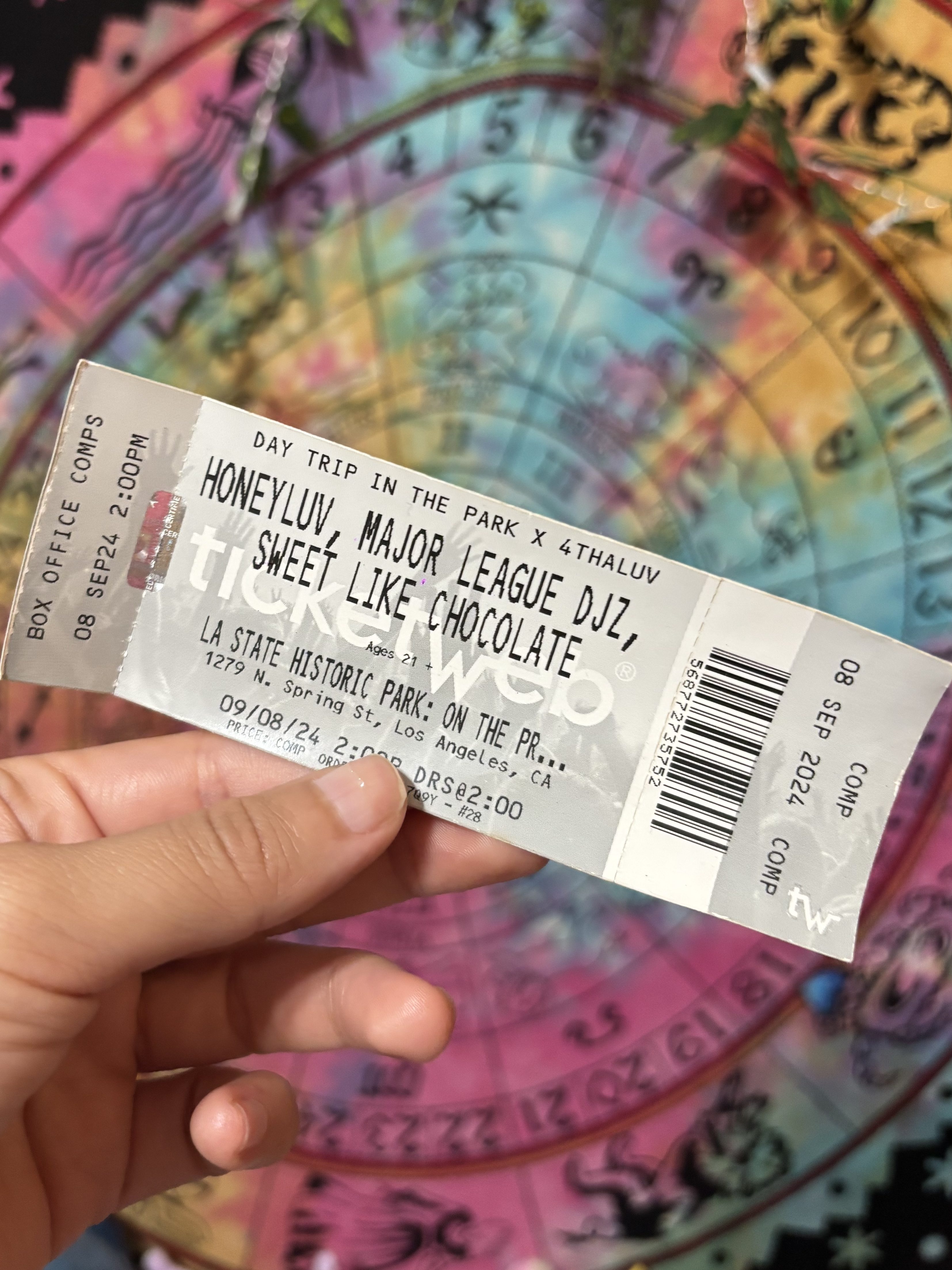
Lastly, I am grateful to have a physical record from this event, something tangible in a world increasingly dominated by the digital. There is a certain power in holding a moment in your hands. Thank you to HoneyLuv for sharing her time, her insight, and the vibrant energy she brings to every set.
Reading Citations:
Hartman, S. V. (2019). Wayward Lives, Beautiful Experiments: Intimate Histories of Social Upheaval. W. W. Norton & Company
Wilson, A. (1990). The Piano Lesson. Dutton. (First Published as a play in 1987)
Fleming, J. B., Jr. (2022). Black Time, Black Geography: The Free Southern Theater. In Black Patience: Performance, Civil Rights, and the Unfinished Project of Emancipation. New York University Press.
 Counter-Archives from the Dancefloor
Leave a comment