
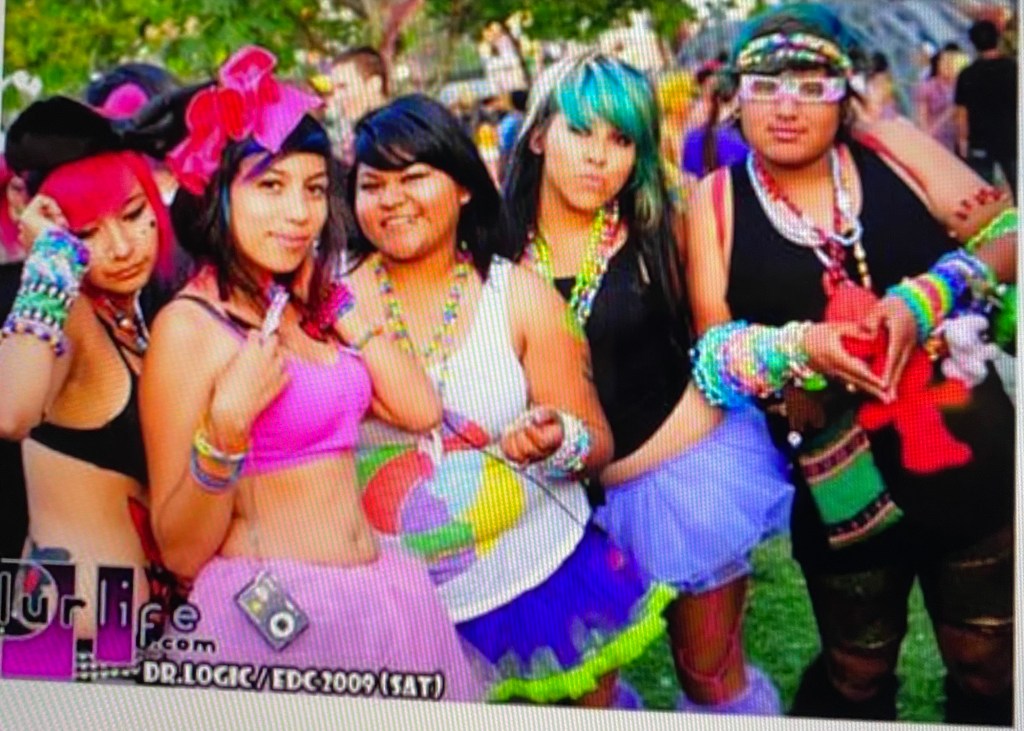
EDC 2009 (Saturday) Left to Right: J, Pinkwhore, Gynawho, Alehzay & La Lucha Sucia.
“We wore flufflies, Hello Kitty backpacks, kandi, glitter and danced all night until the sun rose before anyone called it a bender.” said Molly Margarita, Mama K and La Lucha Sucia in a Story Circle interview.
Rave culture in Southern California (SoCal), more specifically in the city of Los Angeles has been more than a nightlight trend in the late 2000s and early 2010s. This space was a sanctuary where all the “weirdos,” outcasts, and queer people came together through their shared love of music and a commitment to creating and sustaining community. From the MySpace era to contemporary TikTok, the rave scene has evolved with technology and aesthetics creating a generation of party-goers. In this blog, I draw on oral histories from three SoCal ravers, Molly Margarita, Mama K, and La Lucha Sucia who began raving in 2008-2014 and have returned to the scene post-covid pandemic in 2021. Through their memories and counter-archives, I explore the aesthetics, music and social values that define an era and how this transcends time and place for future generations. These testimonies reveal that raving has never revolved around trends. At its core, it is a practice of belonging, self-expression, and a subcultural knowledge across time. Through their narratives, the community’s values of PLUR, and creative resistance highlight what it means to “come out of retirement” not just to dance, but to reclaim space, memory, and meaning within a shifting culture.

The story circle included Molly Margarita, originally from Santa Barbara, began raving in 2010 and took a break in 2014 before making a return in 2022, which she describes as her “coming out of retirement era.”

La Lucha Sucia EDC Los Angeles 2009
When asked who they were when they first started raving, each participant reflected on their early experiences of discovering and accessing the scene. Molly Margarita shared that growing up in a city without raves, she always dreamed of attending one but didn’t have access until her freshman year of college, when her boyfriend at the time had a car. She begged him to take her to Electric Daisy Carnival, especially to see artists like Deadmau5 and Kaskade, who were huge at the time. That first experience, parking near the USC Coliseum and entering a world she had only seen on MySpace, made her feel like she had finally found where she belonged. She recalled how her young parents loved dance music and joked that if they were born in a different era, they probably would’ve been ravers too. For Molly, raving felt like a continuation of that sonic lineage.
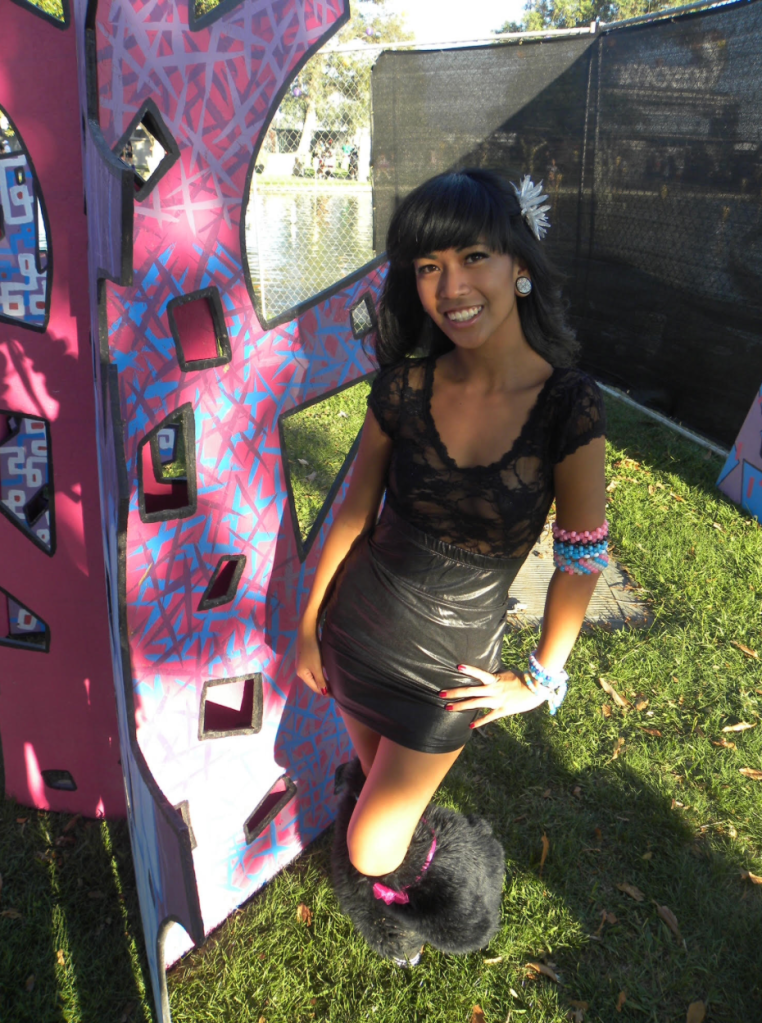
Mama K at Escape from Wonderland at the NOS 2011
Mama K reflected on her early high school years during the MySpace era, attending her first flyer party as a self-described “weird girl” drawn to the freedom, color, and self-expression she saw in rave photos online. Her first official rave was Monster Massive in 2008, where she saw Felix da Housecat perform. That night left a lasting impression, not just because of the music, but because it felt like a space where being different was embraced.
La Lucha, who started raving around the same time, described himself as a nerdy and sheltered kid. Raised in a strict Catholic household in a neighborhood impacted by gang violence, he wasn’t allowed outside much. His entry into the scene came through local underground parties in Montebello and East LA. At just 14 or 15 years old, he relied on buses or his sister for rides. His first large event was “Metroplex” at Pico Sports Arena in the fall of 2008, but he had also been attending Tuesday nights at Club Dance in ARENA, where local DJs like Le Castle Vania and DJ Irene played. Despite their different backgrounds, each of them found in raving a space of discovery, expression, and belonging during their formative years.

DJ Irene playing at Fresh Days @ Pico Sports Arena
I asked them about the music that first drew them into the rave scene, all three participants reflected on the sounds that shaped their early experiences. Molly Margarita identified as a house girl from the beginning, listening to Kaskade and Calvin Harris as some of her early favorites, with Skrillex on that list. While she was never deeply into dubstep or bass music, she was open to it when friends were excited about a set. Over the years, her taste has expanded to include techno, which she has grown to love in more recent years. Mama K also started with house but remembers her earliest connection being to trance listening to artists like Above & Beyond and ATB became the soundtrack to long walks home. She also enjoyed indie remixes, Deadmau5, Laidback Luke, Afrojack, and even ventured into harder genres like hardstyle, naming Showtek’s “FTS” as one of her all-time favorite tracks. La Lucha had the most wide-ranging list, naming DJs like Benny Benassi, Laidback Luke, Steve Angello, Afrojack, David Guetta, Deadmau5, Wolfgang Gartner, Autoerotique, and many more. His musical influences spanned electro house, Dutch house, progressive house, trance, moombahton, trap, tech house, and even the artists who did EDM-pop crossovers of the late 2000s and early 2010s, including collaborations from Rihanna, the Black Eyed Peas, and Kelly Rowland. As a younger raver, he gravitated toward whatever was blowing up at the time, blending old school and mainstream sounds into his evolving taste. Despite differences in genre, what united all three was a deep appreciation for dance music’s emotional pull and power to move bodies and build connection.

Left to Right: Molly Margarita, Miguelito Big Hair, and Ana Banana ready for a rave in Santa Barbara in 2008-09
The fashion choices during their early raving years, painted a picture of color, creativity, and self-expression rooted in the styles of their time. Molly Margarita recalled teasing her voluminous hair, often adding hot pink clip-ins and a Hello Kitty accessory that drew inspiration from early Jersey Shore aesthetics and the “scene queen” look of the late 2000s. She wore bright tutus, daisy-decorated bras, and furry boots, proudly embracing what she called a “whimsical ballerina” style. A friend once told her he could tell she was an old-school raver just by the way she dressed, something that Molly took as a compliment. Mama K’s style was similar: she often shopped in the fashion alleys of Hollywood, putting together looks with lingerie tops, short shorts (often American Apparel dupes), sequined pieces, and her iconic Hello Kitty backpack. Her outfits were always accented by kandi stacked from wrist to elbow, platform flats from CVS, and big, pushed-up hair with extensions. She shared that some of them flew off while on a ride for a festival. For La Lucha, fashion was a way to pay homage to the ravers of the ’90s. His first full outfit featured a black tank top, sparkly gold lamé shorts from American Apparel (regardless of gender labels), matching black fluffies, and bright green hair. Like the others, his arms were covered in kandi, and he described PLUR not just as a slogan but as a style that allowed him to feel bold, visible, and free. Altogether, their early fashion choices were bold statements of identity, colorful, DIY, aesthetics that deeply tied to the sense of belonging rave culture offered.
What is PLUR?
PLUR also came up in our conversation, so I asked Mama K to share what it means to her. She explained that PLUR functions as the community guidelines within rave culture, standing for Peace, Love, Unity, and Respect, with some ravers like herself adding a fifth element: Responsibility. For her, PLUR is about being kind to one another, showing respect, and creating a welcoming, safe environment for everyone. She emphasized that this sets the rave scene apart from other music communities she’s experienced, saying, “I love that crowd more than like other festivals I’ve been to. I’ve been to hip-hop festivals, and it’s just not the same. I love the music, but it’s not the same energy.” Her reflection highlighted that PLUR is not just a phrase but it’s a lived practice that continues to shape how many ravers engage with each other and hold space in increasingly crowded, commercialized festivals.
To close the story circle, I asked the group why they rave, both when they first started and what continues to draw them back today. La Lucha shared that, as a closeted baby queer, raving became a space of liberation and self-expression. “Nobody judged, and everybody danced freely and for the love of music,” he said. These spaces allowed him to form friendships with people from all over Los Angeles and beyond. For him, raving was and still is a place to escape the harshness of everyday life and be his most authentic self.
For Molly Margarita, the love for music has always been at the heart of her rave experience. She grew up dancing and once dreamed of becoming a professional dancer. Although that path didn’t work out, she described going to her first show as a moment of complete freedom and joy. “The community, the friends, the music, I just continue to do it,” she said. Molly often attends shows alone simply because she loves the artist, and the music transports her in ways other things can’t. She views raving as a universal expression of love and connection, the reason festivals like EDC and Tomorrowland even exist. After taking a long break, returning to raving feels like making up for lost time: “I didn’t know how much I craved it until I came back.”
Mama K highlighted these sentiments, describing raving as an outlet that came at a time when she didn’t feel like the “coolest” person. From her very first experience, she was captivated by how welcoming and weird the crowd was (in the best way). “Everyone was so nice,” she recalled. For her, raving was more about community than anything else. It gave her a chosen family, including her closest friend La Lucha, and helped fill the gap of not feeling close to her biological family. She stepped away for a while when life got in the way, but after the pandemic and a flood of virtual raves, she knew she had to return. Her reentry began with DayTrip, and from there she felt reignited. “PLUR is still alive, even if just a little, and I love telling people what it really means,” she said. For Mama K, raving isn’t about getting messed up or chasing chaos, it’s about fun, friendship, community, and making lifelong memories. “I want to do that forever.”
 Counter-Archives from the Dancefloor
Leave a comment