
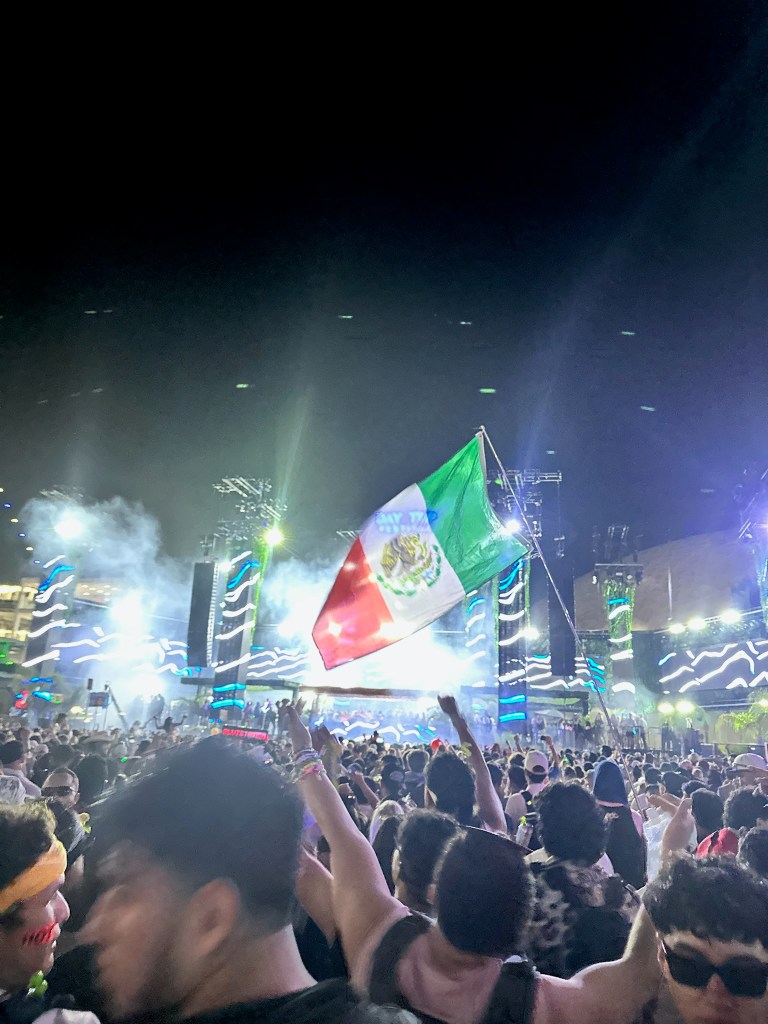
Photo taken by Rave Son 4Loko
In the backdrop of intensifying ICE raids across Southern California in cities like San Diego, the Inland Empire, and Los Angeles, fear pulses through our communities. Peaceful protests are routinely met with police violence, and new legislation continues to make undocumented life more precarious. People are being detained, kidnapped, and criminalized simply for existing. And yet, despite this climate of fear, something unexpected happened at DayTrip Festival: Latinos took up space through flags, outfits, dance, and joy. In a place not typically associated with resistance, we showed up and showed out. Throughout this piece, I use the term “Latinos” intentionally, as it reflects the language many people in my community use to describe themselves. While I recognize the importance of gender-inclusive terms like Latines and Latinx, particularly in academic and activist spaces, I am choosing to honor how people I know self-identify.
I also recognize that attending DayTrip was, in itself, a privilege, one that not everyone has the safety or resources to access, especially amid ongoing ICE raids and the criminalization of undocumented life. As I danced and looked around, I could not ignore the contradiction: joy blooming in one space, while fear tightened its grip in others just miles away. But maybe that is part of what made it so powerful. Latinos at DayTrip were not just partying, we were celebrating. Loudly. Visibly. Together.


Pasquale Rotella Instagram Post on ICE Raids
Just one week before DayTrip Festival, Insomniac founder Pasquale Rotella released a series of Instagram posts framing raves as culture as healing sanctuaries rooted in peace, love, and connection. However, notably absent from his reflections was any mention of the real violence targeting immigrant communities across Southern California. He speaks about “not feeling qualified” to address political issues, upholds PLUR(R) as a form of neutrality, and emphasizes the importance of safe spaces through parties.

Know your Rights by unitedwedream.org
But in a time when ICE raids are terrorizing immigrant families, neutrality is not safety, it is erasure. To claim that a rave is a “sacred space” while refusing to acknowledge the structural violence surrounding it is to miss the very heart of what makes music powerful. While Pasquale emphasizes unity and compassion, he avoids naming the state violence happening just miles away from his festival grounds. There is no mention of undocumented life, no reference to immigration raids, no acknowledgment of the disproportionate fear felt by Latinos in Long Beach and beyond. Instead, we are offered vague affirmations of “energy” and “connection.” These are not inherently harmful but when they stand in place of justice, they ring hollow.
Long before raves became multi-million dollar festivals, Black and brown queer and trans communities were building chosen families through ballroom houses. In the 1960s through the 80s, houses offered more than spaces of performance; they were sanctuaries from homelessness, violence, and state abandonment. Rave families today highlight some of that spirit: groups of ravers who show up for each other with food, water, kandi, and care, forming bonds rooted in survival and joy.
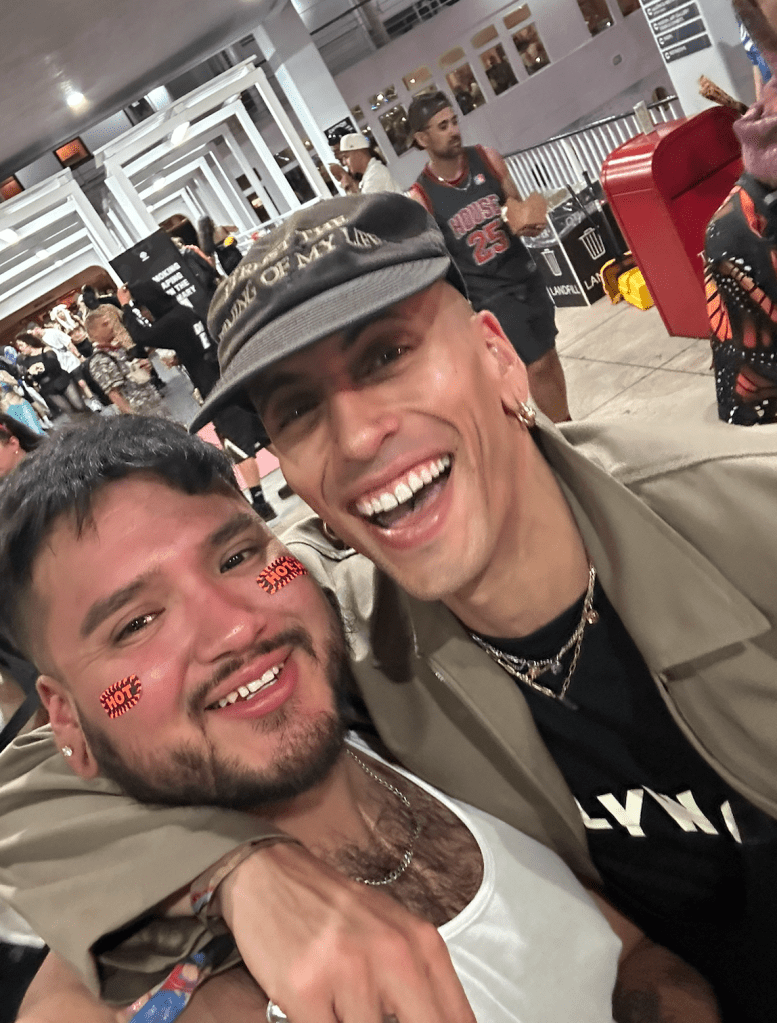
La Lucha Sucia meeting the Iconic Patrick Mason
This presence was also relational. It carried legacy, humor, and queerness. At the DayTrip afters, my best friend La Lucha Sucia met Patrick Mason, a queer Black DJ whose sets are as fierce as his fashion. When my bestie told Patrick 4Loko was his “son,” Patrick laughed and asked, “Oh my god, are you a house? What house are you?” Without missing a beat, our friend La Lucha Lucia replied, “House of Beans.” That moment was full of love and everything. In just three words, it held culture, food, kinship, and resistance. As we danced throughout the festival, my rave family is an example of forming our own houses, on our own terms, rooted in joy, satire, and survival. House of Beans started as a joke but it is a reminder that Latinos, queers, and ravers create meaning in spaces that were never built for us. And we make it beautiful.
Patrick Mason DJing at DayTrip
Moments like that filled with laughter, care, and cultural inside jokes are not separate from politics either. They show how we create belonging and joy in a world that often denies us both. The popular rave motto PLURR (Peace, Love, Unity, Respect, and Responsibility) has always been a political ethic. And now, thanks to creators on platforms like TikTok, we are seeing PLUR(R) reclaimed as protest culture. Infographics like “Bringing PLURR to the Protests” remind us that even joy can be intentional, collective, and defiant.
@eletrica_ali on TikTok discussing PLURR in protests
This is what made DayTrip Festival so significant. In the face of the Insomniac founder’s carefully curated neutrality, Latino festivalgoers transformed the dancefloor into a space of meaning and resistance. Wrapped in the flags of Mexico, Guatemala, El Salvador, and Colombia, they asserted visibility in a place never truly built for them. What José Anguiano calls Latino cultural citizenship was fully alive: the performance of belonging, power, and resistance through cultural expression even within a commercialized and exclusionary soundscape. Joy became a language of survival. Flags became protest. Presence itself became political.
In the following section, I highlight how Latinos reclaimed space at the festival through outfits, flags, and presence that feature moments shared by members of the House of Beans.

Photos taken by Molly Margarita
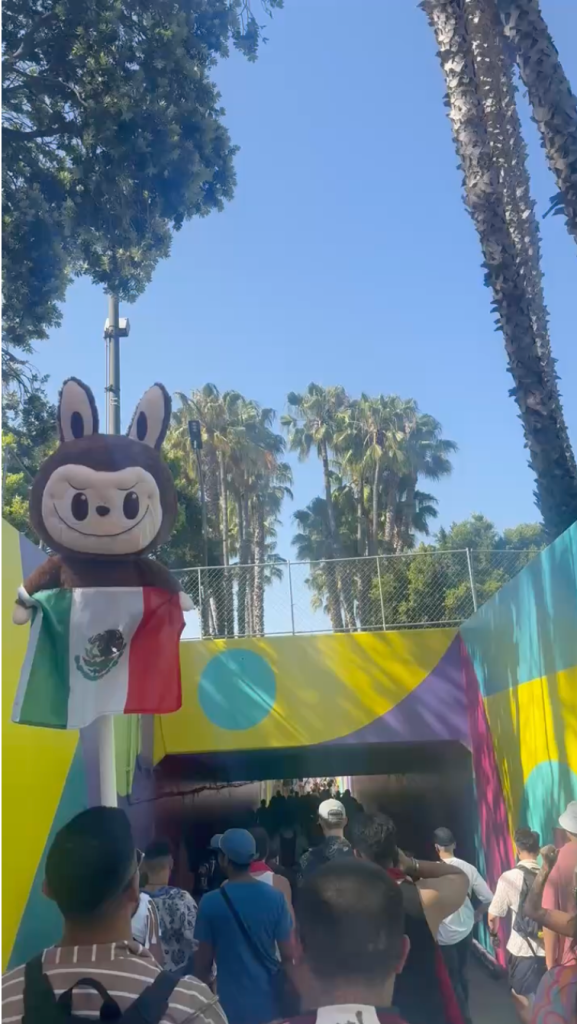

Personal Archive: Fit from day one
Video Taken by Molly Margarita

The girlies from the House of Beans dressed as Butterflies
 Counter-Archives from the Dancefloor
Leave a comment