
Personal Archive
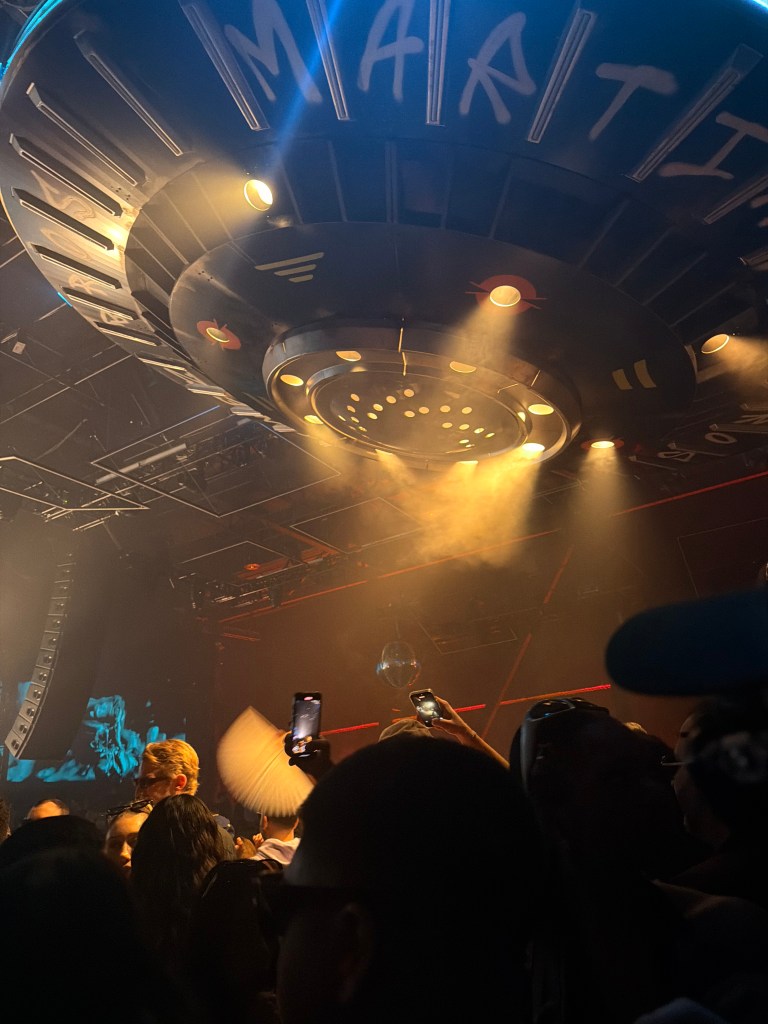
Early February in Los Angeles felt like a cartography lesson taught through the bass.
One weekend, HoneyLuv played at Sound Nightclub. The weekend before, The Martinez Brothers took over Reframe Warehouse. Two different venues. Two different crowds. Two different spatial energies. But both nights mapped what I call sonic geographies where I define this as how sound becomes a vehicle for travel across race, memory, migration, and utopia without ever leaving the dancefloor.
HoneyLuv at Sound

Photo taken from @honeyluv on Instagram
For the first time, I experienced Sound Nightclub filled with Latinos, Black folks, trans and queer people especially backstage. This matters because my past experiences at Sound often meant navigating rooms dominated by white club go-ers: shoving to get to the front, territorial about proximity to the DJ, occasionally confrontational toward my friends when we were simply dancing. The spatial politics were obvious: who feels entitled to the front, who polices movement, who believes closeness equals ownership.
However, HoneyLuv’s night felt different.
My friend Juan leaned over mid-set and said, “there’s so much gayness.” And he meant it with joy. HoneyLuv composed movement across geographies:
- Hip-hop foundations
- Detroit ghetto tech elements
- Afro-house rhythms that felt like I was in the Caribbean
- Ballroom-coded energy through a remix of “WTP”
When she dropped “This Is My Life” (Bontan Remix), the room expanded. When she moved into ballroom-inflected soundscapes, it felt like we were inhabiting a sonic lineage.
This is where I draw from Jayna Brown and her work in Black Utopia, alongside Daphne Brooks in Liner Notes for the Revolution. Both shift from sound studies toward sonic studies which emphasizes feeling, embodiment, sensory immersion, the emotional and political textures of music.
Geography is human activity, memory, power. Therefore, sonic geographies are when music reorganizes spatial experience, when you travel without leaving the dancefloor. When Detroit meets the Caribbean meets ballroom meets LA in one seamless narrative.
In addition, HoneyLuv, in box braids, a beige-and-brown dad hat, baby tee, gold necklace, silver bracelet, nails done reminded us that fashion has never been neutral because tt is spatial authorship. It signals belonging. She reclaimed the room with her fashion, music, and presence.
The Martinez Brothers at Reframe:
The Martinez brothers are a duo (Steve Jr. and Chris) Puerto Rican from the Bronx, New York. Their sound is heavily influenced by the NYC underground club culture.
At Reframe in Glendale, The Martinez Brothers constructed a different map. One track opened:
“Dos hermanos Martinez…”
Then the line:
“Son las cinco de la mañana y quieren que me vaya porque soy illegal… no me dejan pasar pero mi música pasa.”
It was 5AM energy layered with migration politics. In a moment where the Trump administration continues anti-immigrant rhetoric, where ICE deports our people, where brown bodies are surveilled, the repetition of voice mattered.
They blended:
- Hip-hop-coded rhythms (“find me in the club”)
- “This is the sound of the police”
- A remix that sampled Moodymann’s voice, that iconic “Hold on, hold on, fuck that…” restart
- And a remixed Bad Bunny vocal repeating “todos quieren ser Latino”
When they looped “todos quieren ser Latino,” it hit differently. Because white America consumes Latinidad through TikTok trends, food aesthetics, slang, fashion and while simultaneously supporting political regimes that criminalize our communities. This loop was a critique. It asked: Who gets to be Latino as vibe? And who gets deported as body?
Fashion as Spatial Politics
Both DJs were dressed intentionally.
The Martinez Brothers wore pieces by Willy Chavarria, a Mexican-American designer from California’s Central Valley, whose work merges working-class streetwear with 1950s zoot suit silhouettes. Chavarria is now participating in Paris Fashion Week who occupies global fashion space while carrying histories of labor, migration, and Chicano aesthetics. Because when Latino DJs wear Chavarria in LA warehouse spaces, they bring working-class migrant aesthetics into elite global circuits.
Fashion, here, becomes geographic assertion. A refusal to shrink
Sonic Geographies Beyond Time and Space
Both nights showed me this:
Sonic geography is about what sound allows. HoneyLuv moved us through Black diasporic utopias. The Martinez Brothers looped migration politics into 5AM joy. Both nights challenged who the dancefloor belongs to. Music traveled. Bodies traveled. Memory traveled. And for a few hours, LA felt like a counter-archive, one where Black, Latino, trans, and queer people were central. Where music passed even when borders tried to stop bodies.
 Counter-Archives from the Dancefloor
Leave a comment