
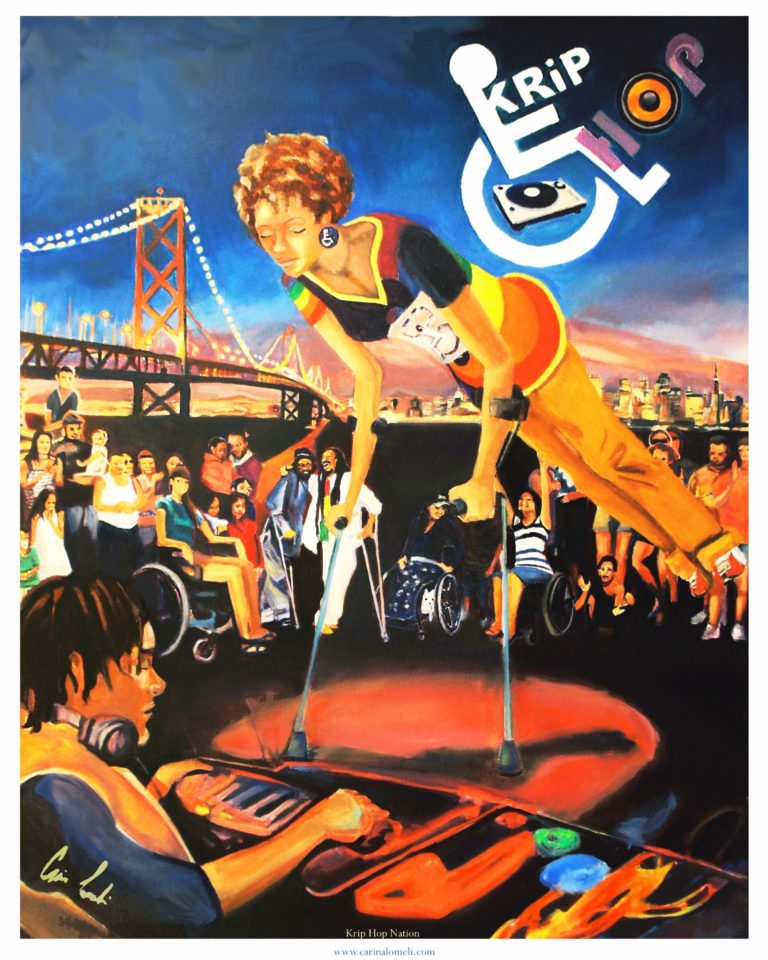
Image from Krip-Hop Institute
On the Fourth of July, I tripped over a pile of rocks, fell, and cracked my knee. It was the first time I had ever cracked or broken a bone in my life. As I left the emergency room on crutches, I quickly realized that something as ordinary as walking had become unfamiliar. I could no longer move at the pace I was used to. I found myself lagging behind my friends, suddenly aware of how quickly they walked. Living in graduate housing, where getting anywhere often requires long walks and flights of stairs, I began to notice parts of my environment that I had previously taken for granted. For example, a staircase, in particular, became something I could no longer ignore because my relationship to my body had changed.
Although the injury has been frustrating, it has also forced me to slow down. Part of me feels like my body is telling me to take a break after months of constantly being on the go such as trying to balance graduate school, research, and weekends spent in nightlife spaces. At the same time, that pause has been difficult to accept. One of my closest friends, who is also a DJ, is visiting this week, and for the first time I cannot go out to support them. Missing nights on the dance floor has made me realize how much I took my own mobility for granted and how quickly an injury can reshape a person’s relationship to music, community, and participation.
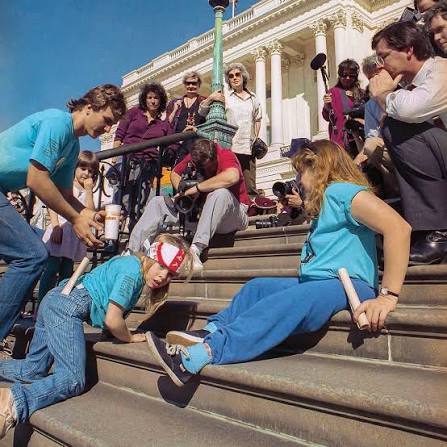
image from @ equalupperarlington via Instagram March 18, 2022
My experience also makes me think about a photograph that had stayed with me from an activist exhibit at the Museum of the City of New York that I visited last month. The image showed Jennifer Keelan-Chaffins, an eight-year-old girl with cerebral palsy, crawling up the steps of the U.S. Capitol during the Capitol Crawl. As she climbed, she famously declared, “I’ll take all night if I have to.” At the time, I understood the photograph as a powerful moment in disability rights history. After my injury, however, I began to understand it differently. Climbing stairs became an embodied experience that made me question why so many spaces are designed with certain bodies in mind. This shift in perspective has also led me to think more deeply about my own research on the intersection of disability, nightlife, and house music, asking who our spaces are built for and who they continue to leave behind.
Disability isn’t just about the body
My injury also pushed me to think differently about disability itself. Before reading disability studies, I might have asked, What is wrong with my knee? This question reflects what disability scholars call the medical model of disability, which focuses on the individual’s impairment and how it can be treated or cured. As Keywords for Disability Studies explains, “disability studies is opposition to the “medical model” of disability, which sees disability in terms of individual impairments to be corrected and cured” (Adams et al., 2015, p. 9). Instead, disability studies frameworks ask a different question: What is it about the environment that assumes everyone can move in the same way? My cracked knee did not create the stairs, the long walking distances, or the inaccessible pathways that suddenly became obstacles. Rather, it revealed how these spaces are designed with certain bodies in mind. As Bess Williamson argues, “Access implies social potential not dependent on correcting the disabled body, but instead made possible through institutional and material change” (Adams et al., 2015, p. 30). This shift from changing bodies to changing environments offers a powerful framework for also thinking about nightlife, clubs, and dance floors, where questions of access are often overlooked.
Space
Rob Imrie describes space as “one of the major axioms of being and of life itself. It is where we are located, the places where we live and move around, and the multiple relationships that take shape among them” (Adams et al., 2015, p. 303). Yet, as he notes, disabled bodies have historically been constructed as “not normal, unsightly, and ‘out of place’” in everyday environments (p. 304). Dance floors, clubs, and festivals are no exception. If these spaces are designed around assumptions of standing, dancing continuously, and moving without assistance, then certain bodies are implicitly treated as the norm while others are marginalized. For many disability rights activists, access is therefore “a nonnegotiable prerequisite for shaping the right to access, occupy, and use space” (p. 306). Applying this perspective to house music shifts the conversation from whether disabled people can fit into existing nightlife spaces to how nightlife itself might be reimagined so that different bodies, movements, and ways of experiencing music are welcomed from the start.
Access is more than ramps
When many people think about accessibility, they often picture a wheelchair ramp. While ramps are essential, disability scholars argue that access extends far beyond a single architectural feature. Bess Williamson explains that access includes the ability to enter, navigate, and fully participate in a space, whether through elevators, accessible bathrooms, transportation, seating, clear pathways, or other accommodations that enable people with different bodies and abilities to move through the world. Yet Williamson also argues that disability studies looks “beyond ramps” (Adams et al., 2015, p. 33). Accessibility also involves sensory, cognitive, and social environments. But what about people with chronic pain who cannot stand for hours? What about someone experiencing fatigue or navigating an invisible disability? What about autistic people for whom loud music, flashing lights, or crowded spaces can become overwhelming? Thinking beyond ramps broadens the understanding of access from entering a space to fully participating in it. It challenges society to imagine environments that welcome a wider range of bodies, minds, and experiences.
What happens to nightlife?
House music emerged from working-class Black, Latinx queer and trans communities as a space of joy, resistance, and collective liberation. Dance floors became places where people who were often marginalized elsewhere could express themselves freely and build community. Yet this history also raises an important question: If house music emerged as a space of liberation, who is still unable to access that liberation today? Disability studies encourages critical thinking about the environments that are created and the bodies they assume. Many clubs, warehouses, and festivals rely on staircases, require attendees to stand for hours, have inaccessible bathrooms, long security lines, limited seating, flashing lights, and loud sound systems with few sensory accommodations. These features may seem ordinary to many attendees, but they can become significant barriers for people with mobility impairments, chronic pain, fatigue, sensory sensitivities, or other visible and invisible disabilities. This begs the question of What kinds of bodies are imagined when clubs and dance floors are designed, and whose bodies are left out?
Embodiment and Performance
Disability studies also encourages thinking about embodiment. How people experience and move through the world in their bodies. As Abby Wilkerson writes, “Embodiment is a way of thinking about bodily experience that is not engaged with recovering the historical mistreatment of disabled people. Rather, it includes pleasures, pain, suffering, sensorial and sensual engagements with the world, vulnerabilities, capabilities, and constraints as they arise within specific times and places” (Adams et al., 2015, p. 124). Since injuring my knee, I have become much more aware of my own embodiment. Walking long distances, climbing stairs, standing for extended periods, and even moving through crowded spaces now require a level of attention that I never had to give them before.
This awareness has also reshaped how I think about dancing and nightlife. Petra Kuppers argues that performance extends far beyond theater or dance. It includes the embodied, social, artistic, and political ways disabled people navigate everyday life, negotiate identity, and challenge assumptions about disability. Through examples ranging from navigating public spaces and interacting with medical professionals to participating in disability pride events and wheelchair dance, Kuppers demonstrates that disability performance exists in both ordinary life and intentional acts of resistance. As she writes, “The performances I described rewrite and examine the scripts of roles in the performances of everyday life” (Adams et al., 2015, p. 248). Her argument invites readers to reconsider what counts as performance and, by extension, what counts as dance. If house music celebrates movement, must that movement always conform to able-bodied expectations? Can sitting, rolling, swaying, using mobility aids, or stimming also be forms of dance? Kuppers presents disabled bodies as creating new ways of moving, expressing joy, and transforming the dance floor itself.
Crip theory
One concept that offers another way of thinking about disability and nightlife is Crip Theory. Before introducing the theory, it is important to understand the meaning of the word crip. As Victoria Ann Lewis explains, crip is an informal form of cripple that was reclaimed during the disability civil rights movement of the 1970s. “Crip” became “an informal, affectionately ironic, and provocative identification among people with disabilities,” offering an alternative to both the rejected term handicapped person and the more formal labels disabled person or person with a disability (Adams et al., 2015, p. 87). Reclaiming the word reflects a broader effort to challenge the stigma attached to disability and redefine disabled identity on disabled people’s own terms. Building on this reclamation, Crip Theory argues that society assumes able-bodiedness in much the same way it assumes heterosexuality, as the unmarked norm around which social institutions, spaces, and expectations are organized. Instead of treating disability as an exception, Crip Theory asks how ideas about “normal” bodies shape everyday life and who is excluded by those assumptions.
Applying this perspective to house music raises another question: What would a crip dance floor look like? A crip dancefloor might include plentiful seating, quiet rooms, wider pathways, wheelchair-accessible entrances and dance floors, lower-sensory areas, and flexible expectations about what dancing looks like. Dancing could include sitting, rolling, swaying, stimming, or moving slowly, recognizing that participation does not depend on a single way of moving. This vision is already reflected in projects such as Krip Hop Nation, founded by Leroy F. Moore Jr. The project highlights the contributions of disabled artists to contemporary music and intentionally spells Krip with a K to distinguish it from gang-related associations. Krip Hop Nation demonstrates that disabled artists have long been creating music, culture, and community, challenging assumptions about who belongs within music scenes and expanding ideas of what performance and participation can look like.
Conclusion
I used to think disability belonged to someone else. A cracked knee made me realize disability is about relationships between bodies and spaces. Every staircase, every dance floor, every warehouse rave now makes me ask who these environments were built for and who they quietly leave behind. If house music has long imagined liberation for marginalized communities, perhaps its next challenge is to imagine liberation that fully includes disabled bodies.This research is still in its early stages and remains an emerging area of inquiry. While my initial work has begun exploring these questions, there is still significant research to be done to better understand the intersectionality of disability and nightlife. I see this as an ongoing project that will continue to develop as I engage more deeply with the scholarship, communities, and lived experiences that shape this intersection.


Leave a Reply